


Let’s be honest.
When someone announces a new commercial solar project, the LinkedIn post usually highlights the system size, the megawatts, the sustainability impact, maybe a drone shot of shiny panels on a warehouse roof.
Nobody posts:
“Thrilled to share our 187-page permit set was approved with zero redlines.”
And yet… that’s often the real win.
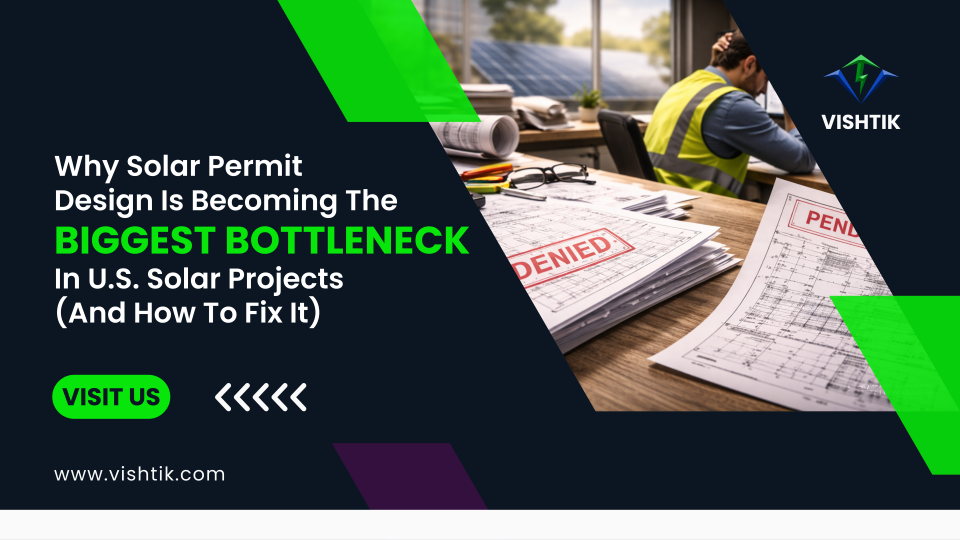
In the U.S. commercial solar market, permit design is where projects quietly succeed, or slowly unravel like a bad extension cord.
Commercial Solar Is Not Just “Bigger Residential”
A 50 kW rooftop system on a home? Manageable.
A 750 kW system on a distribution center with aging roof structure, three-phase service, and utility transformer constraints? That’s a different sport entirely.
Commercial projects bring:
- Complex structural loading
- Wind uplift calculations
- NEC-compliant single-line diagrams
- Service upgrades
- Utility coordination
- Fire code pathway requirements
And here’s the kicker: AHJs know this.
They review commercial permit sets with a magnifying glass. Electrical details must line up perfectly. Structural calcs can’t be “close enough.” Fire setbacks must meet code exactly, not “we think this should work.”
This isn’t paperwork. It’s engineering documentation under scrutiny.
The Real Cost of “Just One More Revision”
Every installer has lived this moment:
You think the permit set is clean.
You submit.
You wait.
Then the comments come back.
- “Clarify conductor sizing.”
- “Provide updated wind load justification.”
- “Revise setback dimensions.”
Individually? Small tweaks.
Collectively? Weeks of delay.
And in commercial solar, delays aren’t abstract. They mean:
- Idle installation crews
- Scheduling conflicts
- Frustrated clients
- Margin compression
If time is money, redlines are inflation.
Utilities Don’t Like Surprises Either
Commercial projects almost always involve utility coordination, and utilities are not in the business of “figuring it out later.”
Transformer specs, protection requirements, interconnection details, if these aren’t aligned early in the permit design phase, you’ll feel it later.
Usually at the worst possible time.
As solar penetration increases across the U.S., utilities are tightening reviews. Interconnection studies are more detailed. Documentation must be precise. Storage integration adds another layer of complexity.
Translation: the days of “we’ll fix it in the field” are over.
Why Commercial Permit Design Is Getting Harder in 2026
The market is maturing.
- NEC enforcement is stricter.
- Fire departments are more particular about rooftop access pathways.
- Insurance providers are asking tougher questions.
- Solar-plus-storage systems add electrical and compliance layers.
Commercial solar used to feel like expansion mode. Now it feels like optimization mode.
The industry isn’t slowing down, it’s getting more disciplined.
And discipline shows up in your permit set.
What a Strong Commercial Permit Package Actually Looks Like
A solid commercial solar permit design includes:
- Detailed structural analysis tailored to the specific roof
- NEC-compliant single-line diagrams with accurate load calcs
- Clear attachment and ballast justification
- Utility-aligned electrical documentation
- AHJ-specific formatting and code references
It’s not about generating drawings quickly. It’s about generating drawings that survive review the first time.
Speed without precision just creates faster delays.
Where Execution Becomes a Competitive Advantage
Here’s something installers don’t always talk about publicly:
The contractor who gets permits approved faster often controls the installation timeline, and the client narrative.
In commercial solar, being technically sound is expected. Being efficient is differentiating.
This is where structured workflows and engineering-backed design support matter. When permit design, revisions, collaboration, and tracking are centralized instead of scattered across emails and spreadsheets, friction drops.
And friction is expensive.
A Quick Word on Support
For commercial installers operating across multiple U.S. jurisdictions, permit design complexity compounds quickly.
That’s where execution-focused partners can make a measurable difference.
Vishtik supports commercial solar permit design with:
- Engineering-backed plan sets tailored for U.S. AHJs
- Structural and electrical precision aligned with NEC standards
- Multi-state expertise
- Fast turnaround without cutting corners
- Collaborative coordination with live design support
- Centralized project tracking for better visibility
The goal isn’t just to produce drawings. It’s to reduce back-and-forth, shorten approval timelines, and protect installer margins.
In a competitive market, that matters.
Final Thought: The Permit Is the Project
Commercial solar gets sold on savings and sustainability.
But it gets delivered through documentation.
You can have the best modules, the most competitive pricing, and a motivated client, but if your permit design is sloppy, everything slows down.
So maybe we should start celebrating clean approvals a little more.
Because in commercial solar, the real flex isn’t just how many megawatts you install.
It’s how smoothly you get there.