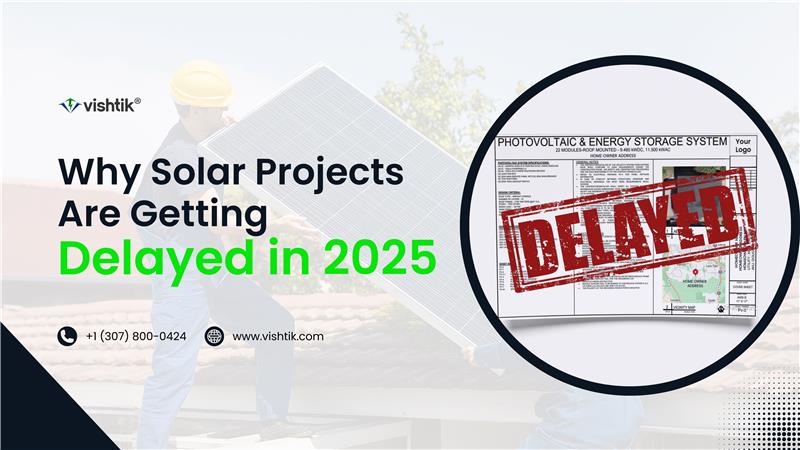





If you ask most solar installers what’s slowing projects down in 2025, you’ll hear familiar answers: permitting backlogs, stricter AHJs, changing utility rules, or “more paperwork than before.” All of that is true, but it’s only part of the story.
From a solar engineering standpoint, many of today’s delays are less about external resistance and more about how projects are being designed, engineered, and submitted for permits. The market has matured. Expectations have risen. And solar projects are no longer moving through approval pipelines on good intentions alone.
At Vishtik Technologies, working across a wide range of U.S. jurisdictions, one thing is consistent: the fastest projects are not the ones rushing to submit, they’re the ones submitting solar permit designs correctly the first time.
The Real Reasons Solar Projects Are Slowing Down in 2025
Permitting Backlogs Are Real — But Solar Permit Design Quality Is the Bigger Factor
There’s no denying that many AHJs are understaffed and overloaded. Solar adoption has outpaced municipal resources in many regions. However, backlog alone doesn’t explain why some projects move smoothly while others stall for weeks or months.
What we consistently see is that well-prepared, code-aligned solar permit designs move through the same AHJs faster. Poorly coordinated engineering creates friction. Clean, complete solar engineering packages reduce it.
AHJs Push Back When Solar Engineering Mistakes Repeat
Inspectors and plan reviewers are not rejecting projects arbitrarily. Most rejections come down to familiar issues tied directly to engineering quality:
- Missing or outdated code references
- Structural assumptions that don’t match site conditions
- Incomplete electrical labeling in solar plans
- Inverter or equipment substitutions not reflected in drawings
- Generic details used where site-specific solar engineering is required
These aren’t edge cases, they’re avoidable solar engineering gaps.
In 2025, AHJs expect solar designs to reflect current NEC and IRC code cycles, local amendments, and realistic installation conditions. Submissions that don’t meet that standard are flagged quickly.
Revision Fatigue: When Poor Solar Permit Design Slows Entire Pipelines
Multiple revision cycles don’t just delay timelines, they slow down entire pipelines. Each resubmission means:
- Lost calendar days
- Rework across engineering and installation teams
- Installer frustration
- Homeowner follow-ups
- Scheduling conflicts downstream
Over time, frequent revisions also affect how reviewers perceive a company’s submissions. Fair or not, consistency matters.
The goal of good solar engineering isn’t perfection, it’s predictability.
Where Solar Engineering Services Make the Difference
Code-Aligned Solar Engineering Reduces Questions Before They’re Asked
One of the biggest misconceptions in the industry is that faster engineering means faster approvals. In reality, accurate solar engineering leads to faster approvals.
When solar permit designs:
- Reference the correct NEC and IRC editions
- Reflect local structural and wind/snow load requirements
- Match utility interconnection standards
- Include clear, readable layouts and engineering notes
…plan reviewers spend less time questioning assumptions and more time approving projects.
Site-Specific Solar Engineering Matters More Than Ever
Cookie-cutter solar designs used to work. In 2025, they rarely do.
Roof types, load paths, fire setbacks, and equipment placements vary too much to rely on templates alone. AHJs are paying closer attention, and they expect solar engineering drawings to reflect what will actually be built, not what’s convenient to submit.
Fewer Revisions Is the New Speed Metric in Solar Permit Design
Speed in solar used to mean turnaround time. Now, it means how many times a project needs to be touched after submission.
A solar permit design that takes an extra day—but avoids two revision cycles, often saves weeks overall. Installers who understand this are already changing how they evaluate their solar engineering partners.
This Isn’t Just an AHJ Problem
It’s easy to point to permitting offices and say, “They’re slowing us down.” In reality, 2025 is asking more from everyone:
- AHJs are managing higher volumes
- Utilities are tightening interconnection rules
- Codes are evolving faster
- Customers expect shorter timelines
The companies that adapt are the ones treating solar engineering and permit design as strategic functions, not back-office tasks.
Better Solar Engineering Gets Projects Built Faster
Solar isn’t slowing down, but the margin for error is shrinking.
Projects get delayed when assumptions replace verification, when speed overrides accuracy, and when solar permit designs aren’t aligned with local expectations. On the other hand, projects move when engineering is thoughtful, current, and coordinated.
At Vishtik Technologies, we believe the future of solar belongs to teams that prioritize first-pass approvals, fewer revisions, and code-ready solar engineering. Not because it sounds good, but because it works.
In 2025, better solar engineering isn’t a luxury. It’s how solar gets built on time.